Healthcare organizations handle highly sensitive information every day, including patient records, medical histories, diagnostic reports, treatment details and insurance information. Protecting this information is essential for patient trust, healthcare operations and international business relationships.
Healthcare providers and technology companies in the UAE that work with US healthcare organizations or handle protected health information may need to understand and implement the requirements of the Health Insurance Portability and Accountability Act (HIPAA).
Businesses searching for a HIPAA license should first understand that HIPAA is a compliance framework and legal requirement for covered entities and business associates under applicable US law. It is not a conventional UAE government-issued business license or a universal official HIPAA certification.
What Is HIPAA?
HIPAA is a US law that establishes requirements relating to healthcare information privacy, security and related administrative responsibilities.
It applies to covered entities, including certain healthcare providers, health plans and healthcare clearinghouses, as well as business associates that perform specific services involving protected health information.
HIPAA compliance focuses on protecting the confidentiality, integrity and availability of protected health information (PHI).
Why HIPAA Compliance Matters in UAE
Healthcare organizations and healthcare technology providers in Dubai, Abu Dhabi and other Emirates may work with US hospitals, healthcare networks, insurance companies, medical technology providers and international healthcare clients.
Depending on their role and contractual obligations, organizations may need to establish HIPAA-aligned controls to protect patient data and meet partner expectations.
HIPAA compliance can help organizations:
Protect sensitive patient information
Reduce risks associated with unauthorized access
Establish secure information-handling procedures
Improve employee awareness of data protection
Strengthen relationships with international healthcare partners
Support contractual and regulatory compliance obligations
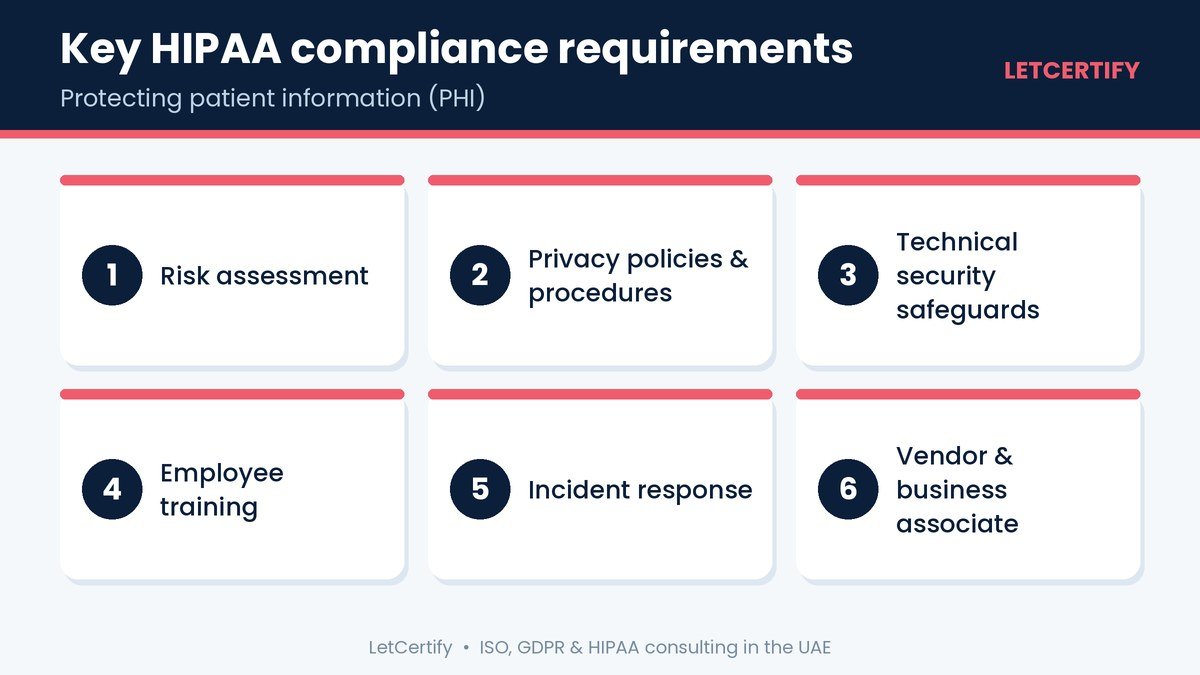
Key HIPAA Compliance Requirements
1. Risk Assessment
Organizations should identify where protected health information is collected, stored, accessed, transmitted and processed. A risk assessment helps identify potential vulnerabilities and prioritize corrective actions.
2. Privacy Policies and Procedures
Documented policies should define how patient information is handled, accessed, disclosed and protected within the organization.
3. Technical Security Safeguards
Appropriate safeguards may include access controls, authentication, encryption, secure backups, monitoring and measures to prevent unauthorized access.
4. Employee Training
Staff should understand how to handle patient information, recognize security risks, maintain confidentiality and follow organizational procedures.
5. Incident Response
Healthcare organizations should establish procedures for identifying, reporting, investigating and responding to potential data breaches or security incidents.
6. Vendor and Business Associate Management
Organizations should review third-party service providers that access, process or store protected health information and establish appropriate agreements and controls where required.
Key HIPAA compliance requirements: protecting patient information (phi)
How to Prepare for HIPAA Compliance
The process generally starts with a gap assessment of existing security and privacy practices. Organizations can then develop policies, implement safeguards, train employees, address identified risks and establish monitoring procedures.
Documentation and evidence of implementation are important because compliance involves more than simply having policies in place.
HIPAA Compliance Consulting in UAE
Healthcare providers, medical service companies, healthcare IT businesses and organizations working with US healthcare clients may benefit from professional compliance guidance.
LetCertify provides HIPAA consulting support, including risk assessments, documentation, policy development, security safeguard guidance, employee awareness and compliance preparation.
If your organization is looking for HIPAA license or compliance support in UAE, LetCertify can help you understand the applicable requirements and develop a structured compliance plan.
Contact LetCertify to discuss your HIPAA compliance needs.
No. HIPAA is a US law and compliance framework for covered entities and business associates. It is not a conventional UAE government-issued license or a universal official HIPAA certification.
Covered entities (certain healthcare providers, health plans and clearinghouses) and business associates handling protected health information. UAE healthcare and healthcare-technology organizations working with US healthcare clients may need to understand and implement its requirements, depending on their role and contracts.
Risk assessment, privacy policies and procedures, technical security safeguards, employee training, incident response, and vendor and business associate management.
Talk to a LetCertify consultant
Get practical guidance on the right standard and a structured plan for your business in the UAE.